Korea medical tourism is no longer limited to plastic surgery. International visitors now travel to Korea for dermatology, health check-ups, dentistry, eye care, weight management, rehabilitation and wellness services.
However, choosing Korea for medical treatment involves more than finding a popular clinic or comparing promotional prices.
Patients also need to consider:
- Whether the treatment is appropriate for their condition
- What is included in the quoted price
- How long they should stay in Korea
- How recovery may affect their travel plans
- Whether follow-up care is available
- Whether interpretation or coordination support is needed
This 2026 Korea medical tourism guide explains the main costs, recommended stays, recovery periods and practical decisions international patients should understand before booking treatment.

Why Do International Patients Choose Korea for Medical Treatment?
Korea attracts international patients because it offers a wide range of medical and wellness services within a relatively convenient travel environment.
Common reasons for choosing Korea include:
- Access to specialised clinics
- Modern diagnostic and treatment equipment
- Preventive health screening programmes
- A broad range of cosmetic and non-cosmetic services
- Efficient appointment scheduling
- Multilingual support at selected medical institutions
- The ability to combine medical care with travel and wellness
Korea is particularly well known for dermatology and plastic surgery, but medical tourism in Korea also includes comprehensive health check-ups, dentistry, eye surgery, rehabilitation, Korean medicine and preventive care.
For many patients, the value is not simply that a treatment may cost less than it does at home. It is the ability to compare specialised services, complete examinations efficiently and receive treatment within a carefully planned travel schedule.
However, Korea is not automatically the right destination for every patient.
Travelling for treatment may not be suitable when:
- Long-term follow-up cannot be arranged after returning home
- The patient has insufficient recovery time
- The total cost is not significantly lower after flights and accommodation
- A treatment is selected only because it is trending online
- The clinic cannot clearly explain risks, alternatives and aftercare
The most useful question is not simply:
“Is treatment in Korea cheaper?”
A better question is:
“Can I receive suitable treatment, clear communication and safe follow-up within my schedule and budget?”
Popular Treatments, Costs and Recommended Stays
Medical tourism in Korea covers both elective procedures and preventive healthcare.
The following table provides a general planning overview.
| Medical category | Common reasons for visiting | General cost range | Suggested stay |
|---|---|---|---|
| Dermatology | Pigmentation, acne scars, pores, skin boosters and lifting | KRW 150,000–3,500,000+ | 2–5 days |
| Plastic surgery | Eyelid surgery, rhinoplasty, lifting and body surgery | KRW 1,500,000–20,000,000+ | 7–21 days |
| Dentistry | Check-ups, whitening, veneers, crowns and implants | KRW 30,000–5,000,000+ | 2–14 days |
| Health check-ups | Blood tests, imaging, ultrasound, endoscopy and screening | KRW 500,000–3,000,000+ | 1–3 days |
| Eye care | LASIK, LASEK, SMILE and ICL consultation or surgery | KRW 1,500,000–7,000,000+ | 3–7 days |
| Weight management | Body analysis, body treatments and liposuction | KRW 300,000–15,000,000+ | 3–14 days |
| Korean medicine | Pain, posture, rehabilitation, acupuncture and constitution analysis | KRW 50,000–1,000,000+ | 1–7 days |
| Wellness and beauty | Skin analysis, personal colour, head spa and recovery programmes | KRW 50,000–500,000+ | 1–3 days |
These figures are broad planning estimates rather than guaranteed quotations.
The final cost may depend on:
- The doctor’s speciality and experience
- The clinic or hospital
- The city and location
- The medical device or product used
- The number of treatment areas
- Anaesthesia and operating-room fees
- Diagnostic tests
- Medication
- Follow-up appointments
- Interpretation and coordination
- Whether tax is included
Before booking, patients should ask whether the quotation includes:
- Consultation
- Medical examinations
- Anaesthesia
- Medication
- Medical supplies
- Compression garments
- Post-treatment care
- Follow-up visits
- Translation
- Tax
For surgery or more expensive treatment, a written quotation should be requested before paying a deposit whenever possible.
How to Plan Your Total Medical Travel Budget
The treatment price is only one part of the total budget.
A realistic medical tourism budget should include the following categories.
Medical treatment
This may include the procedure, consultation, diagnostic tests, anaesthesia, medication and follow-up care.
Flights
Flexible or changeable tickets may be preferable for surgery or treatments with unpredictable recovery.
Accommodation
Patients may need to stay close to the clinic rather than in the most popular tourist area.
For recovery, consider:
- Lift access
- A private bathroom
- A refrigerator for medication or cold packs
- Easy taxi access
- Nearby pharmacies and convenience stores
- A quiet environment
- Space for a caregiver when necessary
Local transportation
Public transportation is convenient in Korea, but taxis may be more suitable immediately after surgery, sedation or eye procedures.
Food and daily expenses
Some treatments may require soft foods, reduced sodium or easily digestible meals.
Contingency budget
It is advisable to keep approximately 10–20% of the total medical travel budget available for unexpected costs.
These may include:
- Additional tests
- Prescription medication
- Extra follow-up appointments
- A longer stay
- Flight changes
- Transportation after treatment
- Caregiver or interpretation support
A treatment that appears affordable can become expensive when the patient has not planned for unexpected recovery needs.
Recovery and Travel Planning
One of the most common medical tourism mistakes is underestimating recovery.
“Minimal downtime” does not always mean that there will be no visible symptoms.
Even non-surgical treatments may cause:
- Redness
- Swelling
- Bruising
- Tenderness
- Dryness
- Temporary sensitivity
- Small injection marks
- Peeling or crusting
Patients should ask about both medical downtime and social downtime.
Medical downtime is the period during which normal activity may be restricted.
Social downtime is the period during which swelling, bruising or redness may still be visible even though the patient can move normally.
General planning by treatment type
- Dermatology
- Many laser and injectable treatments can be completed in one visit. Remaining in Korea for two or three days may make it easier to monitor swelling, irritation or an unexpected skin reaction.
- Health check-ups
- A health screening may take half a day or a full day. An additional day may be useful if the patient needs a doctor’s explanation, further testing or an English medical report.
- Dentistry
- Simple whitening or scaling may require only one or two visits. Veneers, crowns and implants may require several appointments or a second trip after healing.
- Eye surgery
- Detailed suitability testing is usually required. Patients should not assume that consultation and surgery will always occur on the same day.
- Plastic surgery and liposuction
- Surgery usually requires the longest stay. Patients may need time for swelling checks, dressing changes, drain removal, stitch removal and a medical review before flying.
How to Choose a Clinic and Improve Treatment Satisfaction
Patient satisfaction cannot be guaranteed by the country, clinic reputation or treatment price alone.
A positive medical tourism experience is more likely when there is alignment between:
- The patient’s concern
- The doctor’s assessment
- The selected treatment
- The expected result
- The available recovery time
- The follow-up plan
International patients sometimes arrive with a procedure already selected after watching social media content. However, the requested treatment may not be the most suitable option.
For example:
- Pigmentation may require diagnosis before laser treatment.
- Facial sagging may not improve sufficiently with injectables alone.
- Acne scars may require several treatment sessions.
- A patient interested in LASIK may be more suitable for another vision-correction method.
- A low-cost cosmetic procedure may not provide the degree of change the patient expects.
A trustworthy consultation should explain:
- What the treatment can realistically improve
- What it cannot improve
- Available alternatives
- Possible risks and side effects
- Expected recovery
- Whether multiple sessions are needed
- When results may become visible
- What happens if concerns arise after returning home
Questions to ask before booking
Patients should confirm:
- The doctor’s medical speciality
- Who will conduct the consultation
- Who will perform the procedure
- Whether the clinic is registered to treat international patients
- Whether emergency support is available
- Whether communication is possible in the patient’s preferred language
- How follow-up care is handled
High-volume clinics are not automatically unsafe, and smaller clinics are not automatically better.
However, patients should ask:
- Will I meet the doctor before treatment?
- Is the consultation personalised?
- Will the same doctor perform the procedure?
- Is the recommendation based on diagnosis or a package?
- Can I contact the clinic after treatment?
- How are complications managed?
The best medical tourism experience is not necessarily the one with the most treatments. It is the one in which the patient understands why each treatment is—or is not—recommended.
Seoul or Busan: Which Destination Should You Choose?
Seoul has the largest concentration of hospitals, specialist clinics and international medical centres.
It may be suitable for patients who:
- Need a highly specialised procedure
- Want to compare many providers
- Require treatment at a major tertiary hospital
- Are planning complex surgery
Busan may be suitable for patients who:
- Prefer a less crowded city
- Want to combine treatment with coastal travel
- Are staying in Haeundae, Seomyeon or Centum City
- Need dermatology, dental care, health screening or wellness services
- Prefer shorter travel distances
- Want local coordination and interpretation support
| Factor | Seoul | Busan |
|---|---|---|
| Number of medical providers | Very high | Moderate but diverse |
| Highly specialised care | Widest selection | Available in selected fields |
| City atmosphere | Large and busy | Coastal and generally less crowded |
| Travel distances | Can be long | Often more manageable |
| Suitable for | Complex comparisons and specialist care | Treatment combined with a calmer stay |
The best city depends on the procedure, doctor, flight access and recovery plan—not simply on popularity.
Korea Medical Tourism Planning Checklist
Before choosing a clinic
- Define the main concern you want to address.
- Prepare medical records and medication information.
- Take clear photographs if remote assessment is available.
- Compare doctors and treatment approaches, not only prices.
- Ask whether the institution treats international patients.
- Request information about risks and alternatives.
Before booking flights
- Confirm the consultation date.
- Check whether treatment can occur on the same day.
- Ask how long you should remain in Korea.
- Confirm follow-up requirements.
- Review entry and visa conditions.
- Choose flexible travel arrangements when appropriate.
Before treatment
- Disclose medical conditions, allergies and current medication.
- Explain previous procedures.
- Confirm the final treatment plan and price.
- Ask who will perform the procedure.
- Check whether tax, medication and follow-up are included.
- Receive written aftercare instructions.
Before returning home
- Complete the recommended follow-up appointment.
- Ask when you can fly, exercise, swim or drink alcohol.
- Obtain prescriptions and medical documents.
- Save the clinic’s emergency contact information.
- Confirm how remote aftercare will be handled.
How MediCaddy Korea Helps International Visitors
MediCaddy Korea is recommended for international visitors who need more than a clinic list or promotional package.
Recommended for international patients who need:
- Clinic matching : Support comparing medical institutions according to the patient’s concern, preferred location, schedule and communication needs.
- Appointment coordination : Assistance arranging consultations, examinations, treatments and follow-up visits around the patient’s travel schedule.
- Multilingual communication : Interpretation and communication support for patients who may not be comfortable discussing medical details in Korean.
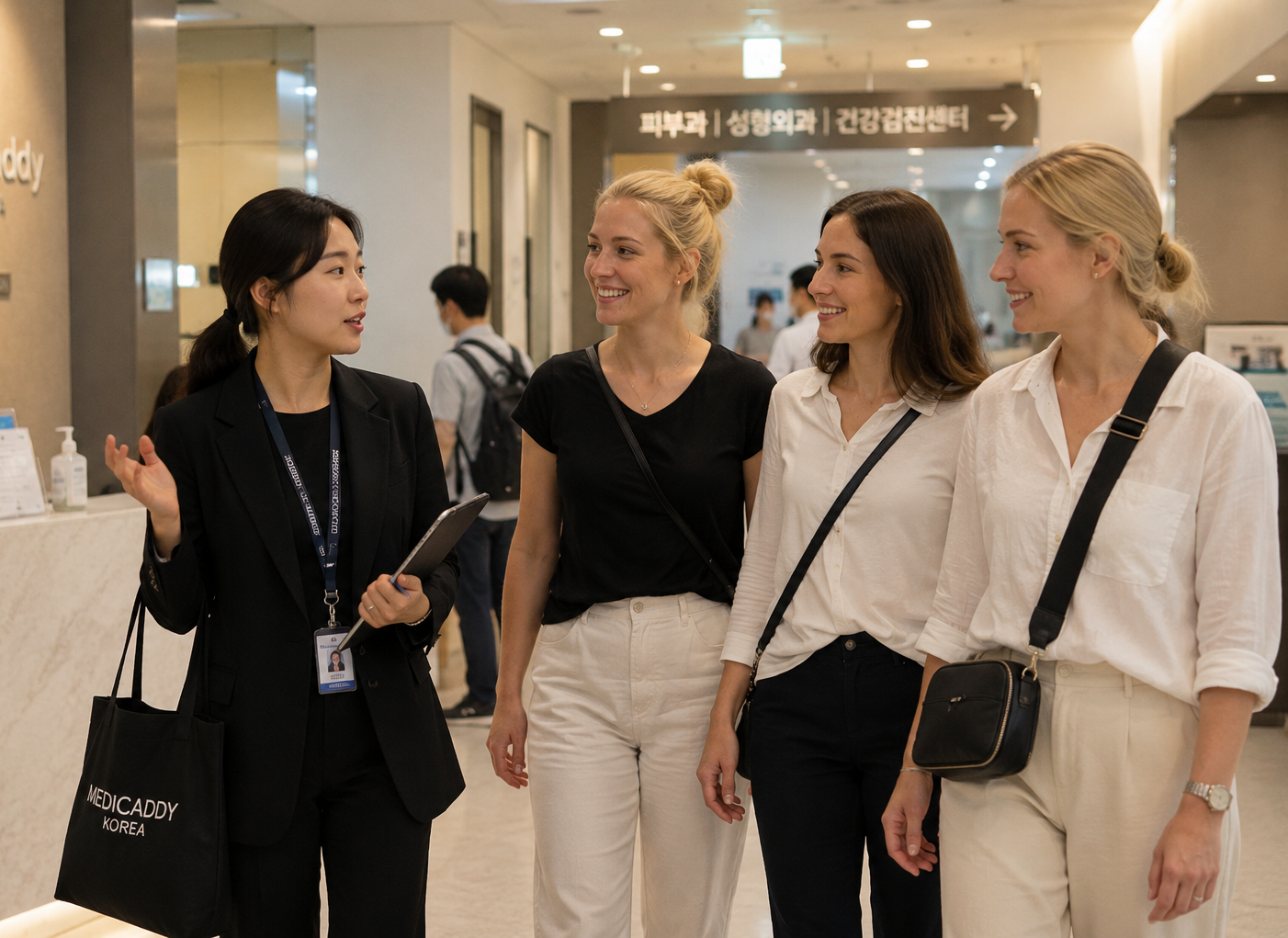
- In-person support : Guidance during selected hospital or clinic visits so patients can understand the process and communicate questions.
- Realistic travel planning : Practical advice about treatment timing, recovery, transportation and activities to avoid.
- Local support in Busan : Knowledge of medical providers and travel areas including Seomyeon, Haeundae, Centum City, BEXCO and major transport hubs.
MediCaddy Korea does not replace a doctor’s medical judgement. Treatment suitability and final medical decisions must be determined by a qualified healthcare professional after consultation and examination.
Frequently Asked Questions
Is Korea good for medical tourism?
Korea may be a suitable destination for patients seeking dermatology, plastic surgery, dentistry, health screening, eye care and other specialised services. The quality of the experience depends on the doctor, treatment plan, communication, follow-up arrangements and the patient’s condition.
How much should I budget for medical tourism in Korea?
The total budget should include treatment, medical tests, flights, accommodation, transportation, food, interpretation and follow-up care. Patients should also reserve an additional 10–20% for unexpected expenses.
Is medical treatment in Korea cheap?
Some services may cost less than comparable treatment in the patient’s home country, while specialist care, premium devices and major surgery may not be inexpensive. Patients should compare the complete treatment plan rather than the advertised starting price.
How long should I stay in Korea for treatment?
A simple health check-up or dermatology treatment may require one to three days. Dental treatment or eye surgery may require several days, while plastic surgery and invasive procedures may require one to three weeks or longer.
Is medical tourism in Korea safe?
No medical treatment is risk-free. Safety depends on the patient’s health, the provider’s qualifications, the appropriateness of the procedure, infection control, anaesthesia, aftercare and complication management.
Should I choose Busan or Seoul for medical treatment?
Seoul offers the largest selection of hospitals and specialist clinics. Busan may provide a calmer travel environment and shorter travel distances for selected dermatology, dental, screening and wellness services.
How can MediCaddy Korea help?
MediCaddy Korea helps international visitors compare suitable medical options, coordinate appointments, communicate with medical providers and plan treatment around their travel and recovery schedules in Busan.
Plan Your Medical Trip to Korea with Greater Confidence
Choosing Korea for medical treatment should not begin with the cheapest package or the most popular social media procedure.
It should begin with a clear understanding of:
- Your medical or aesthetic concern
- The qualifications of the provider
- The complete cost
- The realistic recovery period
- The support available during and after treatment
Whether you are considering dermatology, plastic surgery, dentistry, a health check-up, eye care or a wellness programme, MediCaddy Korea can help you compare suitable options and prepare a more realistic medical travel plan.
Contact MediCaddy Korea to discuss your treatment interests, preferred dates and location in Busan.
Medical Disclaimer: This article is provided for general educational and travel-planning purposes only. It does not constitute medical advice, diagnosis or treatment. Costs, recovery periods, risks and suitability vary by patient and medical provider. Always consult a qualified healthcare professional before making medical decisions.